

Quick Answer: How Much Does It Cost to Move from New York to Florida?
Moving from New York to Florida costs between $1,500 and $11,000 in 2026, depending on the size of your home and the season. Industry data puts a typical 2–3 bedroom full-service move at roughly $2,900 to $6,800, with studios starting near $1,500–$3,000 and 4+ bedroom homes running $6,000–$11,000 or more during peak season. The route covers about 1,100 miles, and delivery typically takes 3 to 10 days after pickup. Costs are driven by shipment weight, time of year, and services included — and NYC building requirements like certificates of insurance and elevator reservations must be arranged weeks in advance.
Every year, tens of thousands of New Yorkers make the move to Florida. Some are chasing the weather. Some are following family. Many are relocating for a different cost of living or a change of pace. Whatever the reason, the 1,100-mile journey from New York to Florida is one of the most traveled moving corridors in the country — and one of the most misunderstood when it comes to what it actually involves.
The truth is that a New York to Florida move has two hard parts, and most people only plan for one. The first is the obvious one: getting your belongings 1,100 miles south. The second is the one that catches people off guard — getting them out of your New York building legally and on schedule. Between certificates of insurance, freight elevator reservations, and city parking permits, a Manhattan or Brooklyn move can stall on the sidewalk before the truck ever hits I-95.
This guide covers both. It was built with input from Xpress Relocations, an IAM-accredited moving company that operates on both ends of this route — with locations in the New York metro area and Miami — and more than 20 years of interstate relocation experience.
For the complete picture of how any long-distance move works, you can also start with our International Moving Process from the USA: Step-by-Step Guide, which covers the same core stages that apply to interstate relocations.
Table of Contents
- How Much Does It Cost to Move from New York to Florida?
- What Actually Drives Your Cost
- Comparing Your Moving Options
- How Long Does the Move Take?
- NYC Building Requirements You Cannot Skip
- When to Move: Peak vs. Off-Peak
- Arriving in Florida: What to Expect
- Common Mistakes on This Route
- Why the Right Mover Matters
- Frequently Asked Questions
1. How Much Does It Cost to Move from New York to Florida?
Cost is the first question everyone asks, and the honest answer is that it depends primarily on how much you’re moving and when you’re moving it.
Here’s what current industry data shows for full-service professional moves on this route, broken down by home size and season:
| Home Size | Approx. Weight | Off-Peak | Peak Season |
|---|---|---|---|
| Studio / 1 bedroom | 2,000 – 3,500 lbs | $1,500 – $3,000 | $2,000 – $4,000 |
| 2 bedrooms | 5,000 – 7,000 lbs | $3,000 – $5,000 | $4,000 – $6,500 |
| 3 bedrooms | 8,000 – 10,000 lbs | $4,500 – $6,500 | $5,500 – $8,000 |
| 4+ bedrooms | 12,000 – 15,000 lbs | $6,000 – $8,500 | $7,500 – $11,000+ |
Cross-referenced across multiple industry sources, a typical 2–3 bedroom full-service move on this route averages roughly $2,900 to $6,800. The full range across all home sizes runs from about $1,300 for a small studio in the quietest month to nearly $9,000 or more for a large home in July.
An important note on these numbers: these are market ranges, not quotes. Two 3-bedroom homes can differ by thousands of dollars depending on packing needs, building access, specialty items, and delivery location within Florida. The only way to know your actual cost is a survey-based estimate from a licensed mover.
2. What Actually Drives Your Cost
Understanding the variables helps you plan realistically — and spot a quote that doesn’t add up.
Shipment weight. Interstate moves are priced primarily by weight, not by room count. Federal rules require your mover to weigh the shipment, and your final cost reflects that weight. This is why decluttering before the move has a direct financial impact: every pound you don’t ship is a pound you don’t pay for.
Season. This is the single biggest swing factor. Summer — roughly May through September — is peak moving season nationally, and prices rise accordingly. The same move can cost 20–30% more in July than in November.
Packing services. Full packing adds meaningful cost but saves significant time and reduces damage risk over a 1,100-mile trip. Partial packing (you handle boxes, professionals handle furniture and fragiles) is a middle path many people choose.
Building access on both ends. A fourth-floor Brooklyn walk-up costs more in labor than a ground-floor townhouse. A Manhattan high-rise with a restricted elevator window costs more than a suburban home with a driveway. This applies at your Florida destination too — a beachfront condo with a loading dock reservation is different from a house in Weston.
Specialty items. Pianos, safes, artwork, antiques, and oversized furniture require special handling and add to the estimate.
Delivery location in Florida. Miami, Tampa, Orlando, and the Panhandle are meaningfully different distances. A move to Jacksonville is shorter than a move to Key West.
3. Comparing Your Moving Options

There are three broad ways to move from New York to Florida, and they involve real trade-offs.
Full-Service Professional Movers
Industry range: roughly $1,300 – $9,000
A licensed interstate carrier handles everything: packing, loading, the multi-day drive, and unloading at your Florida home. They carry federal operating authority (USDOT and MC numbers), provide insurance coverage, and take legal responsibility for your belongings across state lines.
This is the standard choice for households with a full home of furniture, anyone on a schedule, and anyone moving from a building with strict access rules — because a professional carrier handles the COI and building coordination that a rental truck simply can’t.
Moving Containers
Industry range: roughly $1,100 – $5,450
A container is dropped at your home; you pack and load it on your own timeline; the company transports it to Florida. You do the physical work, they do the driving.
The catch on this route: many NYC buildings and streets have no legal place to park a container, and Manhattan curb space is not something you can casually reserve. Containers work far better from suburban New York or a house with a driveway than from a Brooklyn brownstone.
Rental Trucks
Industry range: roughly $950 – $2,540
You rent the truck, load it, and drive 1,100 miles yourself. The lowest sticker price — but the number rarely includes fuel for a 1,100-mile haul, tolls, lodging on a multi-day drive, equipment rental, or the labor to load and unload. And you carry all the risk.
The honest comparison: the cheapest option on paper is rarely the cheapest option in practice on this route. Between fuel, tolls, hotels, and the physical toll of loading a full home twice, the gap between a rental truck and a professional move narrows considerably — while the difference in risk, time, and stress does not.
4. How Long Does the Move Take?
The New York to Florida route runs roughly 1,100 miles, which is a 2–3 day drive under normal conditions. But your delivery window is a different question from drive time.
Typical delivery: 3 to 10 days after pickup, depending on how your shipment is transported.
Here’s why the window exists: most interstate household moves travel as consolidated shipments. Your belongings share truck space with other households heading in the same direction. This is standard practice across the industry and it’s what keeps interstate moving accessible — but it means your delivery date depends on the route’s schedule, not just the drive.
If you need a guaranteed date, ask about dedicated or expedited service, where your shipment travels alone. It costs more, but it delivers on a fixed schedule.
Plan your timeline like this:
| Stage | Timing |
|---|---|
| Start planning | 8 – 12 weeks before |
| Book your mover | 6 – 8 weeks before |
| Request COI & reserve elevator | 3 – 4 weeks before |
| Secure NYC parking permit | 2 – 3 weeks before |
| Packing & loading | 1 – 2 days |
| Transit to Florida | 3 – 10 days |
| Delivery & unloading | 1 day |
5. NYC Building Requirements You Cannot Skip

This is where New York moves go wrong — and it has nothing to do with the 1,100 miles.
Most NYC co-ops, condos, and professionally managed rentals will not let a moving crew touch the freight elevator without paperwork on file. If it’s missing, incomplete, or filed late, your movers wait on the sidewalk while the clock runs.
Certificate of Insurance (COI)
A COI is a document your mover’s insurer issues to your building, confirming general liability coverage and naming the building and its management company as additional insureds for your move date.
- Required by most NYC residential buildings, particularly those with more than six units, doormen, or professional management
- Liability limits typically required between $1 million and $5 million, depending on the building
- Processing generally takes 24–48 business hours, but can take 3–5 additional business days if your building specifies a particular insurance carrier
- Request it at least 5–7 business days ahead — earlier for co-ops, which tend to be strictest
The detail that matters: every building’s COI requirements are different. A COI that doesn’t match the building’s exact specifications gets rejected, and you start over. A mover experienced with NYC buildings prepares these to each building’s specs as a matter of routine. A mover who isn’t may not be able to produce one at all.
Freight Elevator Reservation
Buildings assign move windows — typically 2–4 hour blocks on weekdays — to prevent overlap between residents and protect common areas. In high-rises with heavy move volume, these slots fill up, and during peak season availability tightens considerably.
Book 1–3 weeks ahead. Without a confirmed reservation, building staff can turn your crew away regardless of when the truck arrives.
Parking Permits
NYC DOT issues temporary “No Parking” permits for moving trucks. In Manhattan and dense parts of Brooklyn and Queens, this is the difference between loading at the curb and circling the block on the clock.
Move-In and Move-Out Fees
Many buildings charge them, and in luxury properties they can range from $250 to $2,000. Ask your building management early so it’s in your budget, not a surprise.
The two-ended advantage: Florida has its own version of this. Miami Beach, Brickell, and Fort Lauderdale condos have COI requirements, elevator reservations, and loading dock rules of their own. A mover who handles both ends of this route deals with the same paperwork twice — and knows it going in.
6. When to Move: Peak vs. Off-Peak
Timing is the one variable that can move your cost by thousands without changing anything else about your move.
Peak season (May – September): Highest demand, highest rates, tightest availability. Elevator slots in NYC buildings are harder to book. If you must move in summer, book as early as possible.
Off-peak (October – April): Better rates, better availability, more scheduling flexibility. Mid-month and mid-week beat the end of the month, when leases turn over and everyone moves at once.
The best-value window on this route tends to be late fall through winter — you avoid both the summer premium and the NYC winter weather risk if you go before the deep freeze.
7. Arriving in Florida: What to Expect
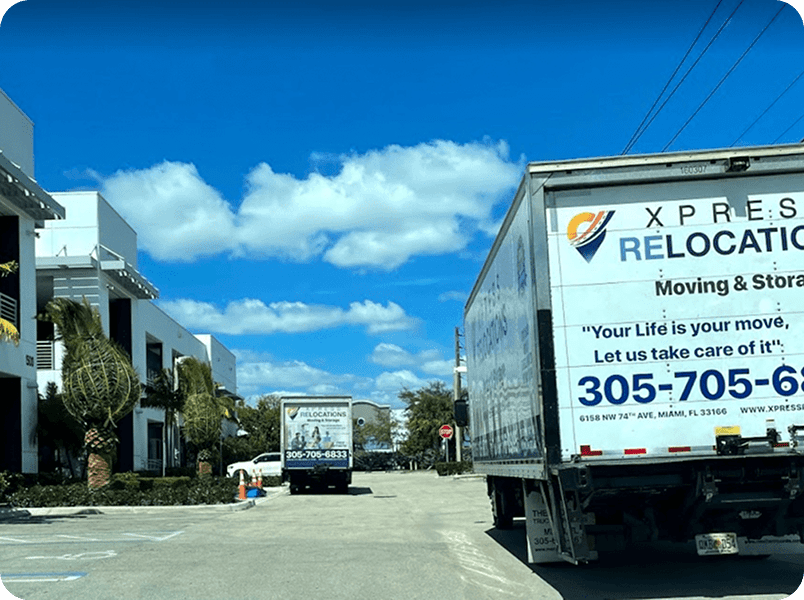
Your move doesn’t end when the truck crosses the state line.
Building requirements apply here too. If you’re moving into a condo in Miami Beach, Brickell, Fort Lauderdale, or any managed building, expect COI requirements, elevator reservations, and possibly restricted move hours. Confirm these before your shipment arrives, not after.
Plan your delivery window. Because most shipments are consolidated, you’ll get a delivery window rather than a fixed date. Make sure someone can be present, and don’t schedule anything critical against that window.
Check your inventory on arrival. Confirm every item against the inventory before signing off, and document any issues immediately — that’s what protects your claim.
Then there’s the practical stuff: Florida driver’s license and vehicle registration, utilities, and updating your address with USPS, banks, and the IRS.
One thing worth flagging: many people move from New York to Florida partly for tax reasons. Florida has no state income tax, and New York has specific rules about establishing domicile and residency that go well beyond simply moving your furniture. This is genuinely complex and the rules matter — talk to a qualified tax professional or attorney about your specific situation before you assume anything. We’re movers, not tax advisors, and this is one area where getting it wrong is expensive.
8. Common Mistakes on This Route
Booking too late. Peak season books out. So do NYC freight elevators. Late booking means fewer options and higher rates.
Ignoring the COI until move week. The number one cause of a stalled NYC move. Request it weeks ahead, and confirm your building accepted it.
Hiring a broker instead of a carrier. This is the most expensive mistake on interstate routes. A broker has no trucks and no crew — they collect your deposit and resell your job to whoever bids lowest. You have no idea who shows up at your door or who has custody of your belongings for 1,100 miles. Verify any company’s USDOT and MC numbers on the FMCSA site before signing anything.
Trusting a quote that’s dramatically lower than the rest. On a route this well-traveled, pricing is competitive and reasonably consistent. A quote far below the others usually means one of three things: it’s a broker, it excludes services you’ll need, or it’s a lowball that gets revised upward once your belongings are on the truck.
Not decluttering. You’re paying by weight for 1,100 miles. Everything you don’t ship is money you don’t spend.
Skipping the survey. Estimates without a real inventory — in-home or virtual — are guesses. Guesses get revised, usually upward.
9. Why the Right Mover Matters on This Route
A New York to Florida move is a licensed interstate operation with real regulatory requirements on one end and real building logistics on both. It’s not a job for whoever answers the phone first.
What to verify before you sign:
- Active USDOT and MC numbers (check them yourself at FMCSA’s site)
- They are a carrier, not a broker — their own trucks, their own crew
- They can produce COIs to your building’s exact specifications
- A written, survey-based estimate — not a phone guess
- Experience with this specific corridor
Xpress Relocations operates on both ends of this route. We have locations in the New York metro area and in Miami, with over 20 years of interstate and international relocation experience. We’re IAM-accredited and BBB A+ rated, and we’re a direct carrier — our trucks, our crew, our responsibility from your New York door to your Florida home. We handle the COI paperwork on both ends, because we deal with those buildings routinely.
Xpress Relocations LLC 📞 (305) 705-6833 📱 WhatsApp: 786-267-3302 ✉️ customerservice@xpressrelocations.com 🌐 www.xpressrelocations.com
Licensed & Insured · DOT# 2438489 · FL Reg# IM2521 · IAM Accredited · BBB A+
👉 Request Your Free New York to Florida Quote
Moving to South Florida specifically? See our local service areas for Miami Beach, Fort Lauderdale, Hollywood, Weston, and Pembroke Pines. Relocating a business instead? See our office moving services.
10. Frequently Asked Questions
How much does it cost to move from New York to Florida? Industry data puts a full-service move from New York to Florida between roughly $1,500 and $11,000 in 2026, depending on home size and season. A typical 2–3 bedroom move averages about $2,900 to $6,800. Studios start near $1,500–$3,000 off-peak, while 4+ bedroom homes can exceed $11,000 during peak summer months. Your actual cost depends on shipment weight, timing, packing, and building access, so a survey-based quote is the only accurate number.
How long does it take to move from New York to Florida? The route is about 1,100 miles — a 2–3 day drive. Typical delivery is 3 to 10 days after pickup, because most household shipments are consolidated with others traveling the same direction. Dedicated or expedited service delivers on a fixed schedule for an additional cost.
Do I need a Certificate of Insurance to move out of my NYC building? Most likely, yes. Most NYC co-ops, condos, and managed rentals — especially those with more than six units — require a COI naming the building and management as additional insureds, typically with $1 million to $5 million in liability coverage. Request it at least 5–7 business days ahead; processing takes 24–48 business hours, longer if your building specifies a particular carrier.
When is the cheapest time to move from New York to Florida? Off-peak months (October through April) generally offer better rates and availability than peak season (May through September), where the same move can cost 20–30% more. Mid-month and mid-week dates also tend to price better than end-of-month.
Should I use a moving container or full-service movers for a New York to Florida move? It depends heavily on where you’re moving from. Containers cost less but require legal space to park them, which is difficult or impossible in Manhattan and much of Brooklyn. Full-service movers handle the loading, the drive, and the building paperwork, and are the practical choice for most NYC apartment moves and for anyone on a fixed schedule.
How do I know if a moving company is legitimate? Verify their USDOT and MC numbers on the FMCSA website before signing anything. Confirm they’re a carrier with their own trucks and crew, not a broker reselling your job. Ask for a written, survey-based estimate and confirm they can produce a COI to your building’s specifications.
Do I still pay New York taxes after moving to Florida? Florida has no state income tax, but New York has specific rules around domicile and residency that determine your tax obligations, and they involve more than just moving. This is a complex area with real financial consequences — consult a qualified tax professional or attorney about your specific circumstances.
Last updated: July 2026. Cost figures are aggregated market ranges from industry sources and are provided for planning purposes only — they are not quotes. Actual pricing depends on shipment weight, season, services, and access, and requires a survey-based estimate. Building requirements vary by property. For consumer guidance on interstate moving and to verify a mover’s federal authority, consult the Federal Motor Carrier Safety Administration at https://www.fmcsa.dot.gov/protect-your-move. Tax and residency matters should be discussed with a qualified professional.