

Colombia has become one of the most popular relocation destinations for Americans — and for good reason. A comfortable lifestyle that would cost $3,000–$5,000/month in a major US city runs closer to $1,200–$2,000/month in Medellín or Bogotá. Add warm weather year-round, a growing remote-work community, world-class healthcare at a fraction of US prices, and visa pathways designed specifically for retirees and digital nomads, and it’s easy to see why over 60,000 Americans now call Colombia home.
But a successful move takes more than a plane ticket. Between choosing the right visa, understanding what it actually costs to live there, deciding which city fits your lifestyle, and shipping your belongings through customs, there’s a lot to get right.
This guide walks you through all of it. It was put together with input from Xpress Relocations, an IAM-certified moving company based in Miami with over 20 years of experience helping people relocate from the USA to Colombia. For the full picture of how an international move works, you can also start with our International Moving Process from the USA: Step-by-Step Guide.
Table of Contents
- Can Americans Move to Colombia?
- Visa Options for Americans (2026 Income Requirements)
- How Much Does It Cost to Live in Colombia?
- Best Cities in Colombia for Expats
- Healthcare in Colombia
- Shipping Your Belongings and Customs
- Common Mistakes to Avoid
- How to Get Started with Xpress Relocations
1. Can Americans Move to Colombia?
Yes. US citizens can legally move to Colombia, and the process is relatively straightforward if you can show a steady monthly income. The key is choosing the right visa for your situation and preparing your documentation correctly.
Americans can enter Colombia visa-free as tourists for up to 90 days (extendable to 180 days per year), but to live there long-term you’ll need a proper visa. The good news is that Colombia offers several pathways designed specifically for the kinds of people moving there — retirees, remote workers, investors, and families.
📘 Free Guide: Moving from the USA to Colombia
Download our free step-by-step relocation guide and get instant access to everything you need to plan your move with confidence — visas, costs, timelines, customs, and common mistakes to avoid.
👇 Fill out the form below and get your free guide instantly.
2. Visa Options for Americans (2026 Income Requirements)
Colombia issues visas in three categories — V (Visitor), M (Migrant), and R (Resident) — with roughly fourteen subtypes between them. Here are the ones most Americans actually use, with the real 2026 income thresholds.
Important context: Most income requirements are pegged to Colombia’s minimum wage (SMMLV), which for 2026 is COP 1,750,905/month. Because thresholds are tied to the peso and converted at the exchange rate on the day your file is reviewed, apply with a 10–15% buffer above the minimum to protect against currency swings.
Digital Nomad Visa (Visa V)
The most popular option for remote workers. You must earn income from foreign sources (no Colombian employers or clients) of at least 3× the minimum wage — approximately COP 5,252,715/month (~$1,400 USD) in 2026.
Key details:
- Valid up to 2 years
- Income must clear the threshold each month individually — the Cancillería does not average
- Proof is via bank statements (invoices and tax returns alone are not sufficient)
- Requires all-risk health insurance covering the full visa period, including repatriation
- Does not count toward permanent residency
- Note: this visa had a high rejection rate in 2025 (~42% by third-party tracking), almost always due to sloppy documentation — apply carefully
Pensionado (Retirement) Visa (Visa M)
For retirees with a certified lifetime pension. You need to prove pension income of at least 3× the minimum wage — approximately COP 5,252,715/month (~$1,380–1,410 USD) in 2026.
Key details:
- Social Security, military, and private pensions all qualify
- Investment, rental, or freelance income does not qualify — it must be a recognized pension
- Offers a path to permanent residency (Visa R) after 5 continuous years
- Lower rejection rate than the Digital Nomad Visa (~10–15%)
Investment Visa (Visa M)
For those investing in Colombia:
- Real estate: minimum 350× minimum wage (~$167,000 USD in 2026)
- Business: minimum 100× minimum wage (~$48,000 USD in 2026)
Marriage / Spouse Visa (Visa M)
For those married to a Colombian citizen or resident. This is the fastest route to permanent residency — you can apply for your Resident (Visa R) after just 3 years.
Work Visa (Visa M)
Requires sponsorship from a Colombian employer. In practice this is uncommon for Americans, since Colombian salaries are low relative to US wages and companies face bureaucratic hurdles sponsoring foreign workers — the main exception being multinationals transferring employees.
Government Fees (2026)
Fees are two-part: a study fee (~$52–55 USD) paid on application, plus an issuance fee paid only on approval — approximately $177 (Visa V), $230–270 (Visa M), or $400 (Visa R). Add document apostilles, certified translations, and optionally an immigration attorney.
After approval: You must register with Migración Colombia within 15 days of arrival and get your Cédula de Extranjería (foreigner ID card, ~$60–65 USD). You’ll need it for nearly everything — opening a bank account, signing a lease, getting a SIM card.
3. How Much Does It Cost to Live in Colombia?
This is the number one reason most people move. A single person can live comfortably in Colombia on $1,200–$2,000 USD per month, including rent, food, transportation, and leisure. That same lifestyle would cost $3,000–$5,000 in a comparable US city.
Here’s a realistic monthly breakdown for a comfortable expat lifestyle in a major city:
| Expense | Monthly Cost (USD) |
|---|---|
| Rent (furnished 1-bedroom, safe neighborhood) | $400 – $900 |
| Groceries | $150 – $300 |
| Dining out & entertainment | $150 – $300 |
| Health insurance (private) | $40 – $150 |
| Transportation | $30 – $100 |
| Utilities & internet | $80 – $150 |
| Total (comfortable single) | $1,200 – $2,000 |
A few things that affect your budget:
The estrato system. Colombia rates neighborhoods 1–6 by socioeconomic level, and this affects utility rates. Most expats live in estrato 4–6 areas. An estrato 4 neighborhood can be 30–50% cheaper than estrato 6 with similar safety.
Coastal AC costs. Highland cities (Medellín, Bogotá) enjoy 65–75°F year-round with no need for air conditioning. Coastal cities (Cartagena, Santa Marta, Barranquilla) run hot and humid — budget an extra $60–$150/month in electricity for AC. This hidden cost often flips the apparent value of “cheaper” coastal cities.
The exchange rate. Dollar earners have benefited from a weak peso in recent years (roughly 3,200 COP/USD in 2020 to ~3,800 today). A 10% swing moves your monthly costs by $100–$150, so always check the current rate.
4. Best Cities in Colombia for Expats
Choosing the right city — and the right neighborhood within it — is one of the most important decisions you’ll make.
Medellín — The City of Eternal Spring

The most popular expat and digital-nomad hub. Spring-like weather year-round (no heating or AC needed), excellent infrastructure, the country’s only metro system, and a huge remote-work community.
- El Poblado: upscale, international, English-speaking — furnished 1BR runs $600–$1,200
- Laureles: leafier, more local, walkable — $400–$700 for similar quality
- Envigado: cheaper still and very livable
- Most longtime residents move from El Poblado to Laureles after their first lease once they realize how much further the money goes
Bogotá — The Capital

Colombia’s business and cultural center. More cosmopolitan, more job opportunities, international schools, and the widest housing supply at every price point. Cooler climate due to its high altitude (8,660 ft). Popular expat areas include Usaquén, Chapinero, and Chicó.
Cartagena — The Caribbean Jewel
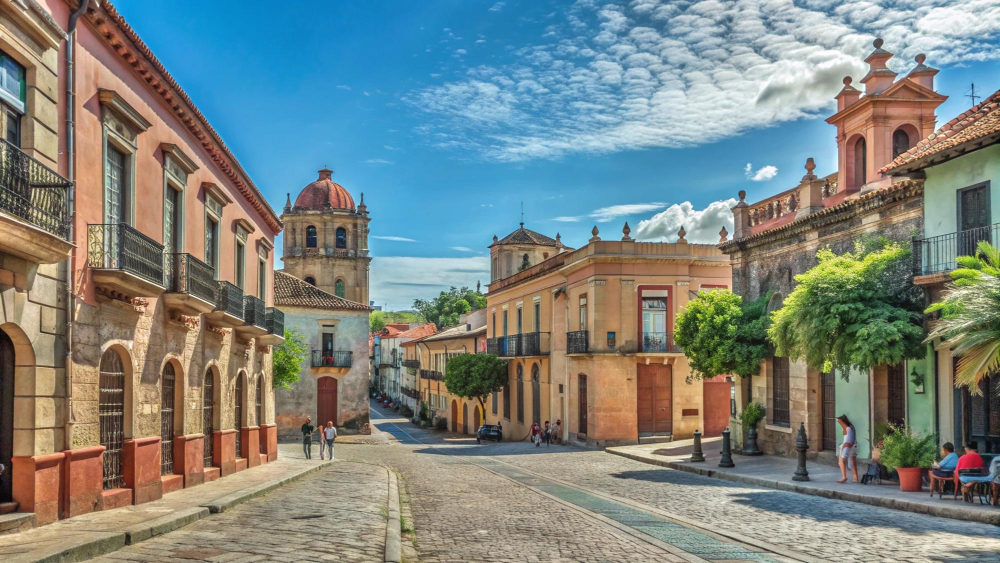
A UNESCO World Heritage city with colonial architecture and Caribbean beaches. Warm year-round, walkable, and rich in culture and festivals. Costs more than inland cities (tourism premium + AC costs). Bocagrande and Manga are safe, popular expat neighborhoods.
Other Cities Worth Considering
- Cali: salsa capital, warm, lower cost, growing digital-nomad scene
- Barranquilla: large modern Caribbean city, cheaper than Cartagena despite being nearby
- Bucaramanga, Pereira, Manizales: smaller cities in and near the Coffee Triangle with no expat premium — comfortable living from $1,000–$1,500/month
5. Healthcare in Colombia
One of Colombia’s biggest draws. Healthcare is high-quality and remarkably affordable — the country consistently ranks well for medical quality in Latin America.
How it works:
- Public system (EPS): Once you have legal residency and your cédula, you can enroll. Monthly contributions run roughly $30–$80 USD depending on declared income, covering everything from doctor visits to surgeries — though wait times can be long.
- Private insurance (prepagada): Many expats add private coverage for shorter waits and English-speaking doctors, typically $40–$150/month depending on age and coverage.
- Out of pocket: A private GP visit runs $10–$50 USD. Even without insurance, private care is dramatically cheaper than in the US.
Important: Proof of health insurance covering your full stay is now mandatory for most visa applications. Your US Medicare and most domestic plans do not cover you in Colombia. Many expats start with an international plan (like SafetyWing) and transition to the local EPS system once they have their cédula.
6. Shipping Your Belongings and Customs

Once your visa and destination are settled, the next question is what to do with your belongings. You have two broad options: sell everything and start fresh, or ship what matters to you.
If you’re shipping, most household moves to Colombia use ocean freight — either a shared container (LCL) if you’re moving a smaller household, or a full container (FCL) for a whole home. Ocean transit from Miami runs roughly 6–12 days to Cartagena, with total door-to-door time of about 4–8 weeks including customs clearance.
The customs side is where most moves get delayed. Colombia’s household goods regime (menaje doméstico) lets you import your belongings at a single flat tax of 15% — but only if you meet the residency requirements and have your documentation in order. The most commonly overlooked document is the Certificate of Residence Abroad, issued by the Colombian Consulate in the US.
Because customs is detailed and getting it wrong means costly delays and storage fees, we’ve written a dedicated guide covering the exact documents, the 15% tax, the Return Law (Ley 1565) exemption for returning Colombians, prohibited items, and port selection:
👉 Customs Requirements for Moving to Colombia: What You Need to Know
For a full cost breakdown of shipping by container type, see our guide on the cost of moving to Colombia from the USA, and for container and delivery details, our guide on shipping to Colombia from the USA.
📦 Planning Your Move to Colombia?
Get a free, no-obligation quote tailored to your specific move — we’ll assess your volume, destination, and timeline and get back to you within 24 hours.
7. Common Mistakes to Avoid
After 20 years of coordinating moves to Colombia, these are the mistakes we see most often:
Choosing the wrong visa or submitting a sloppy application. The Digital Nomad Visa in particular rejects a high share of applicants — almost always for income proof that doesn’t match the application, missing apostilles, or vague proof of remote work. Get your documents apostilled and translated before you open the portal.
Underestimating the coastal AC cost. A “cheaper” coastal city can end up more expensive than a highland city once you add year-round air conditioning.
Not visiting first. Colombia is diverse. Spend time in your shortlisted cities — ideally a few weeks — before committing. Many experienced expats recommend renting for the first year or two before buying anything.
Trusting a broker instead of a direct mover. This is the most costly shipping mistake. A broker collects your deposit, resells the job to the cheapest bidder, and sometimes disappears entirely. A direct operator like Xpress has its own trucks, warehouse, and accountability. We cover this in detail in our customs guide.
Undervaluing your shipment at customs. Declaring unrealistic values to “save” on the 15% tax backfires — DIAN has reference-value databases, and a mismatch means your container gets held, re-inspected, and ends up costing more than you saved.
8. How to Get Started with Xpress Relocations
If you’re planning a move from the USA to Colombia, the first step is a free consultation to assess your volume, destination, and timeline.
Why Xpress Relocations:
- 20+ years relocating people from the USA to Colombia
- Direct operator — our trucks, our warehouse, our responsibility. We are not brokers.
- IAM-accredited (International Association of Movers) and BBB A+
- Complete documentation guidance before shipping
- Strategic port selection based on your final destination
- Network of agents in Colombia for customs clearance and door-to-door delivery
- Bilingual service — we assist you in Spanish and English
Xpress Relocations LLC 📞 (305) 705-6833 📱 WhatsApp: 786-267-3302 ✉️ customerservice@xpressrelocations.com 🌐 www.xpressrelocations.com 📍 Miami, FL | New York | Texas | California
IAM Accredited · BBB A+ · 20+ Years of Experience
The Xpress Way — Stress-Free Moving
Frequently Asked Questions
Can US citizens move to Colombia permanently? Yes. Americans can move to Colombia permanently by obtaining the appropriate visa and eventually qualifying for permanent residency (Visa R). The Pensionado and Marriage visas both offer paths to residency.
How much money do I need to live comfortably in Colombia? A single person lives comfortably on $1,200–$2,000 USD per month in a major city like Medellín or Bogotá — roughly 50–70% less than a comparable US lifestyle.
What is the easiest visa for Americans moving to Colombia? The Digital Nomad Visa (for remote workers earning foreign income) and the Pensionado Visa (for retirees with a certified pension) are the most common. The right one depends on your income source.
What’s the best city in Colombia for expats? Medellín is the most popular for its spring-like climate and remote-work community, followed by Bogotá for opportunities and Cartagena for coastal living. The best fit depends on your priorities around climate, cost, and lifestyle.
How do I ship my belongings to Colombia? Most moves use ocean freight (shared LCL or full-container FCL) from Miami, with total door-to-door time of about 4–8 weeks. See our dedicated customs requirements guide for the documentation and tax details.
Do I need health insurance to move to Colombia? Yes. Proof of health insurance covering your full stay is mandatory for most visa applications, and US Medicare does not cover you in Colombia.
Last updated: July 2026. Visa income thresholds are based on Colombia’s 2026 minimum wage and Cancillería’s current fee schedule; because they’re pegged to the peso, exact USD amounts vary with the exchange rate. Cost-of-living figures are estimates and vary by city, neighborhood, and lifestyle. For immigration and tax matters, consult a qualified Colombian professional. Customs information is based on current DIAN regulations.