

Moving from the United States to Spain is one of the most significant decisions you’ll make — and one of the most logistically complex. Between choosing the right visa, understanding what shipping your belongings actually costs, and navigating Spanish customs requirements, there’s a lot that can go wrong if you’re not working with the right information.
This guide was put together with input from Xpress Relocations, an IAM-certified international moving company based in Miami with over 20 years of experience coordinating USA-to-Spain relocations. Everything here — costs, timelines, documents — reflects what actually happens on the ground, not what it looks like on paper.
If you want a complete overview of how an international move works from start to finish, start with our International Moving Process from the USA: Step-by-Step Guide.
Table of Contents
- What You Need to Know Before You Start Planning
- Visa Options for Americans Moving to Spain
- How Much Does It Cost to Ship Your Belongings to Spain?
- How Long Does a Move from the USA to Spain Take?
- Customs Requirements and Documents for Spain
- The Broker Problem: A Real Story
- How to Get a Quote from Xpress Relocations
1. What You Need to Know Before You Start Planning
Most people underestimate how early the planning process needs to start. A USA-to-Spain move isn’t like a domestic relocation — you’re dealing with ocean freight scheduling, international customs, visa processing timelines, and Spanish bureaucracy, all at the same time.

A realistic planning window is 4 to 6 months before your target move date. Here’s why: the Baja Consular alone — a document we’ll cover in the customs section — can take several weeks to process at the Spanish Consulate in the US, and without it, your belongings can get held at the port in Spain and you may have to pay a significant deposit to release them.
The other thing to settle early is your visa. Without an approved visa, you don’t have a legal residency status in Spain, and without residency, you can’t complete the customs paperwork for your belongings.
📘 Free Guide: Moving from the USA to Spain
Not sure where to start? Download our free step-by-step relocation guide and get instant access to:
- Visa requirements explained step by step
- Complete relocation checklist
- Cost-saving strategies
- Common mistakes to avoid
- Packing tips for international moves
👇 Fill out the form below and get your free guide instantly.
2. Visa Options for Americans Moving to Spain
As a US citizen, you can’t simply move to Spain on a tourist visa and stay indefinitely. You’ll need to apply for a long-stay visa (visado de larga duración) through the Spanish Consulate in the United States. Here are the main options:
Non-Lucrative Visa (NLV)
The most common choice for retirees and people with passive income. It allows you to live in Spain without working locally. Requirements include proof of sufficient financial means — typically around €2,400/month for a single applicant — private health insurance, and a clean criminal record. It’s renewable annually and can lead to permanent residency after 5 years.
Digital Nomad Visa (DNV)
Introduced in 2023, this visa is designed for remote workers and freelancers who earn income from clients or employers outside Spain. You need to demonstrate at least 3 months of work history with your current client or employer, proof of income (minimum €2,646/month as of 2026), and health insurance.
Work Visa
If you have a job offer from a Spanish company, your employer typically sponsors this visa. The process involves labor market authorization from Spanish authorities and can take 3 to 6 months.
Student Visa
For those enrolling in accredited Spanish institutions. Allows part-time work and can be a pathway to longer-term residency.
Important: Regardless of which visa you choose, you’ll need to apply for your NIE (Número de Identidad de Extranjero) once you arrive in Spain. This is your foreign identification number and you’ll need it for virtually everything — opening a bank account, signing a lease, and completing customs clearance on your shipment.
3. How Much Does It Cost to Ship Your Belongings to Spain?
This is the question we get most often, and the honest answer is: it depends on your volume, your port of destination, and the services included. Here are real price ranges from Xpress Relocations based on actual jobs coordinated from Miami to Spain:
LCL — Shared Container (Studio or 1-Bedroom Apartment)
$1,500 – $3,500 USD
LCL (Less than Container Load) means your belongings share space in a container with other shipments. You only pay for the cubic footage your items actually occupy, which makes it the right choice if you’re moving a smaller household.
What’s included in Xpress Relocations’ LCL service:
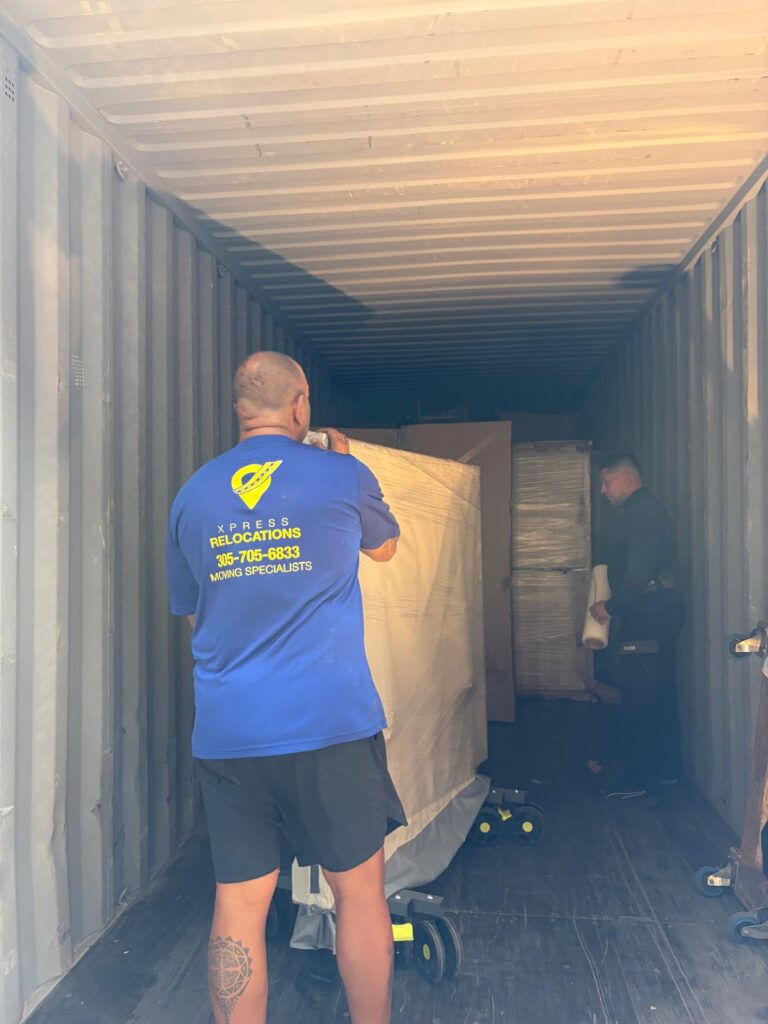
- Professional packing of all furniture (labor, moving blankets, stretch wrap, reinforced cardboard)
- Inventory preparation and documentation
- Loading and securing in the container
- Ocean freight Miami to Spain
- Customs coordination in Spain

Note: Packing of boxes (clothing, kitchenware, books, personal items) is quoted separately. You can pack your own boxes and only contract the furniture service, or request full packing of the entire home.
FCL — Full 20-Foot Container (2 to 3-Bedroom Home)
$3,000 – $10,000 USD
A full container gives you exclusive use of a 20-foot shipping container. The cost variation depends on the final city within Spain (delivery to Madrid costs more than delivery to a coastal city), whether full packing is included, and the specific port of entry.
Cargo Insurance
Insurance is optional but strongly recommended for international shipments. Xpress Relocations offers All-Risk coverage at 3% of the declared value of your goods. On a shipment declared at $20,000 USD, that’s $600 — a minimal investment compared to the risk of arriving in Spain with damaged or lost items after 3 to 4 weeks at sea.
For a complete breakdown of all cost factors — including packing, insurance, port fees, and delivery within Spain — see our detailed guide: Cost of Moving to Spain from the USA: Full Breakdown (2026 Guide).
📋 Get a Free, Personalized Moving Quote
Costs vary depending on your volume, destination, and services. Get a clear, itemized estimate with no hidden fees — tailored to your specific move to Spain.
4. How Long Does a Move from the USA to Spain Take?
Total door-to-door time from Miami to Spain is typically 4 to 8 weeks under normal conditions, broken down as follows:
Ocean Transit Times by Port
| Route | Transit Time |
|---|---|
| Miami → Algeciras | 13 – 16 days |
| Miami → Valencia | 16 – 22 days |
| Miami → Barcelona | 20 – 28 days |

Which port is right for you?
- Algeciras is the fastest route and the main transshipment hub at the Strait of Gibraltar. Best if your final destination is in southern Spain (Málaga, Sevilla, Cádiz).
- Valencia is generally the best option for central and eastern Spain — Madrid, Murcia, Valencia city, and surrounding areas.
- Barcelona is ideal for Catalonia and the northeast.
Full Timeline Breakdown
| Stage | Duration |
|---|---|
| Packing and loading at origin (Miami) | 1 – 3 days |
| Ocean transit | 2 – 4 weeks |
| Spanish customs clearance (with complete documentation) | 5 – 10 business days |
| Final delivery at destination in Spain | 2 – 5 additional days |
Critical note on customs: If your documentation is incomplete — especially if the Baja Consular is missing — customs clearance can stretch to 3 or 4 weeks, or you’ll be required to deposit 25% of the declared value of your goods to release the shipment while you gather the paperwork.
For a detailed breakdown of each stage and what to expect week by week, see our full guide: How Long Does It Take to Move to Spain from the USA? Full Timeline Guide.
5. Customs Requirements and Documents for Spain
Importing your household goods into Spain without paying import duties and VAT is possible through a customs exemption (franquicia aduanera) for people establishing residency. To qualify, you need to present the following documents:
Required Documents for Spanish Customs
1. Valid Passport Original, in force. Spanish citizens may also use their DNI. Foreign residents in Spain need their NIE.
2. Detailed, Valued, and Signed Inventory A complete list of every item being imported, with individual descriptions and values in euros. Must be written in Spanish. Xpress Relocations prepares and signs this inventory during the loading process at origin.
3. Baja Consular Certificate ⚠️ (Critical Document) Issued by the Spanish Consulate in the US (Miami, New York, Houston, or other locations). This document certifies that the client has been formally deregistered from the Consular Registry as a resident abroad. It is mandatory for Spanish citizens returning to Spain and essential for the customs exemption.
What happens if you don’t have it:
- You can pay a deposit equivalent to 25% of the declared value of your goods to release the shipment
- You have 6 months to present the Baja Consular and recover the deposit
- If you don’t present it within that window, you lose the deposit permanently
Request this document from the Spanish Consulate as early as possible — it can take several weeks.
4. Empadronamiento Certificate Proof of registration in the Padrón Municipal (municipal register) of the town where you’ll live in Spain. Important: the date of registration in Spain must be after the date of the Baja Consular.
You should initiate this process as soon as you arrive in Spain and have a fixed address — whether it’s a property you’ve purchased, rented, or even a family member’s home.
5. Customs Clearance Authorization A form authorizing Xpress Relocations’ customs agent in Spain to process the clearance on your behalf. We prepare this document as part of our service.
6. Customs Exemption Application (DUA) The Declaración Única Aduanera with the codes corresponding to the VAT and tariff exemption for change of residency. Handled by our customs agent in Spain.
7. Bill of Lading The document issued by the shipping line identifying the container, shipment, and parties involved. Provided by Xpress Relocations after loading.
When Do You Need to Be Registered in Spain?
You should begin the empadronamiento process as soon as you arrive and have a fixed address. Spanish regulations require that goods be declared for free circulation within 12 months of establishing residency in the EU.
It’s also possible to import your belongings before you physically arrive in Spain, as long as you sign a commitment to establish residency within a maximum of 6 months from the date of customs clearance.
If you’re also planning to ship furniture specifically, review our guide on Shipping Furniture to Spain from the USA: Complete Guide (2026) for packing requirements, container options, and what to expect at Spanish customs for large items.
6. The Broker Problem: A Real Story

Not every company that offers to move your belongings to Spain is actually a moving company. This is something we see more often than we’d like.
A client came to us after a difficult experience with another company they had found online. The quote looked excellent — low price, fast response, and a process described as “no complications.” They paid a deposit of $1,200 USD.
Within days, responses started taking longer. After two weeks, no one was answering the phone. After three weeks, the number was disconnected.
What the client didn’t know is that they had never contracted a moving company. They had contracted a broker — an intermediary that collects the deposit, passes the job to the lowest bidder, and in this case simply disappeared with the money.
When they came to us, we had to start the entire process from scratch. They lost the deposit. They lost three weeks. And they came close to missing their flight to Spain.
The difference between a broker and a direct operator like Xpress Relocations:
A broker has no trucks, no crew, and no physical custody of your belongings. They only have your deposit.
Xpress Relocations is the direct operator: our trucks, our crew, our responsibility — from the moment we arrive at your door in the US to the moment we deliver to your home in Spain. We are IAM-certified, BBB A+ rated, licensed and insured.
Want to understand the full moving process before committing? Read our International Moving Process from the USA: Step-by-Step Guide so you know exactly what to expect at every stage — and the right questions to ask any company you’re considering.
7. How to Get a Quote from Xpress Relocations
If you’re planning a move from the USA to Spain, the first step is a free consultation to assess your volume and specific needs. Our team will review your inventory, destination, and timeline and provide a clear, itemized quote — no hidden fees, no surprises.
Xpress Relocations LLC 📞 (305) 705-6833 📱 WhatsApp: 786-267-3302 ✉️ customerservice@xpressrelocations.com 🌐 www.xpressrelocations.com 📍 Miami, FL | New York | Texas | California
IAM Member · BBB A+ · Licensed & Insured · 20+ Years in International Relocation
The Xpress Way — Stress-Free Moving
📦 Ready to Start Your Move to Spain?
Whether you’re ready to book or just exploring your options, our team is here to help. Get a free, no-obligation quote tailored to your specific move — we’ll get back to you within 24 hours.